
Ethos of Care Initiative
Dr. Emily SkopResearch Summary
This project advances a campus-wide “Ethos of Care” initiative designed to center empathy, belonging, and mutual support into the fabric of the university experience. Building on research-backed frameworks, the project introduces a reimagined engagement model that includes a 2-day immersive convening supported by 8 weeks of guided pre-work for staff, faculty, and institutional leaders. The entire curriculum and convening are designed to reduce harm by disrupting the hyper-competition and isolation often found within higher education and professional workplaces.
The experience is designed to be both reflective and actionable to create space for participants to engage deeply with care-centered practices while building shared language and strategies for institutional change. A complementary series of short-form, progressive videos extends the reach of the program, offering accessible “Tidbits of Care” that introduce concepts such as Creative Self Care, Community Care, Curriculum Care, and Structural Care. Together, these elements create a scalable, human-centered approach that promotes connection and sustainable practices to address the systems and structures that lead to burnout and undermine wellbeing to ultimately strengthen institutional culture.
The Problem: Higher education systems often prioritize outcomes over people, leading to fragmented support, limited collaboration, and missed opportunities to fully engage students and professionals as whole beings. Without intentional structures that center care, institutions struggle to create environments where individuals can thrive and contribute meaningfully. Many programs focus entirely at the individual-level work for mindfulness, de-stress, and productivity hacks to address the symptoms of destructive organizational culture (i.e. burnout). Fewer programs address the root causes of harm at the institutional level.
The Innovation: This project reimagines institutional culture by embedding an “Ethos of Care” into the academic experience. By adapting existing research-backed frameworks into scalable training, workshops, and collaborative models, it creates actionable pathways for individuals and institutions to prioritize care as a driver of innovation and success. The work seeks to disrupt embedded power imbalances and enhance policies and practices at the organizational-level, as a way to shift academic culture away from hyper-competition and isolation and instead center empathy, belonging, and mutual support. In other words, the ethos of care framework recognizes how institutions are made of both systems and structures, as well as hearts and minds.
Community and Industry Impact
This project strengthens the UCCS community by creating shared experiences and tools that reduce harm, foster connection, and promote a culture of care across roles and departments. By centering real-world practices and accessible content, it supports a more inclusive, collaborative, and resilient campus environment.
Student Engagement and Mentorship
The initiative creates meaningful opportunities for engagement and mentorship by bringing together students, faculty, staff, and leaders in a shared learning environment. Through the convening, pre-work, and ongoing content, participants build relationships, exchange perspectives, and develop skills that support both personal growth and professional collaboration.
Increasing UCCS Visibility
By positioning care as a driver of innovation, this project elevates UCCS as a leader in forward-thinking, community-engaged practices. The combination of immersive programming and scalable digital content increases the university’s visibility as a hub for transformative ideas, institutional change, and applied research in higher education.
Photo Gallery
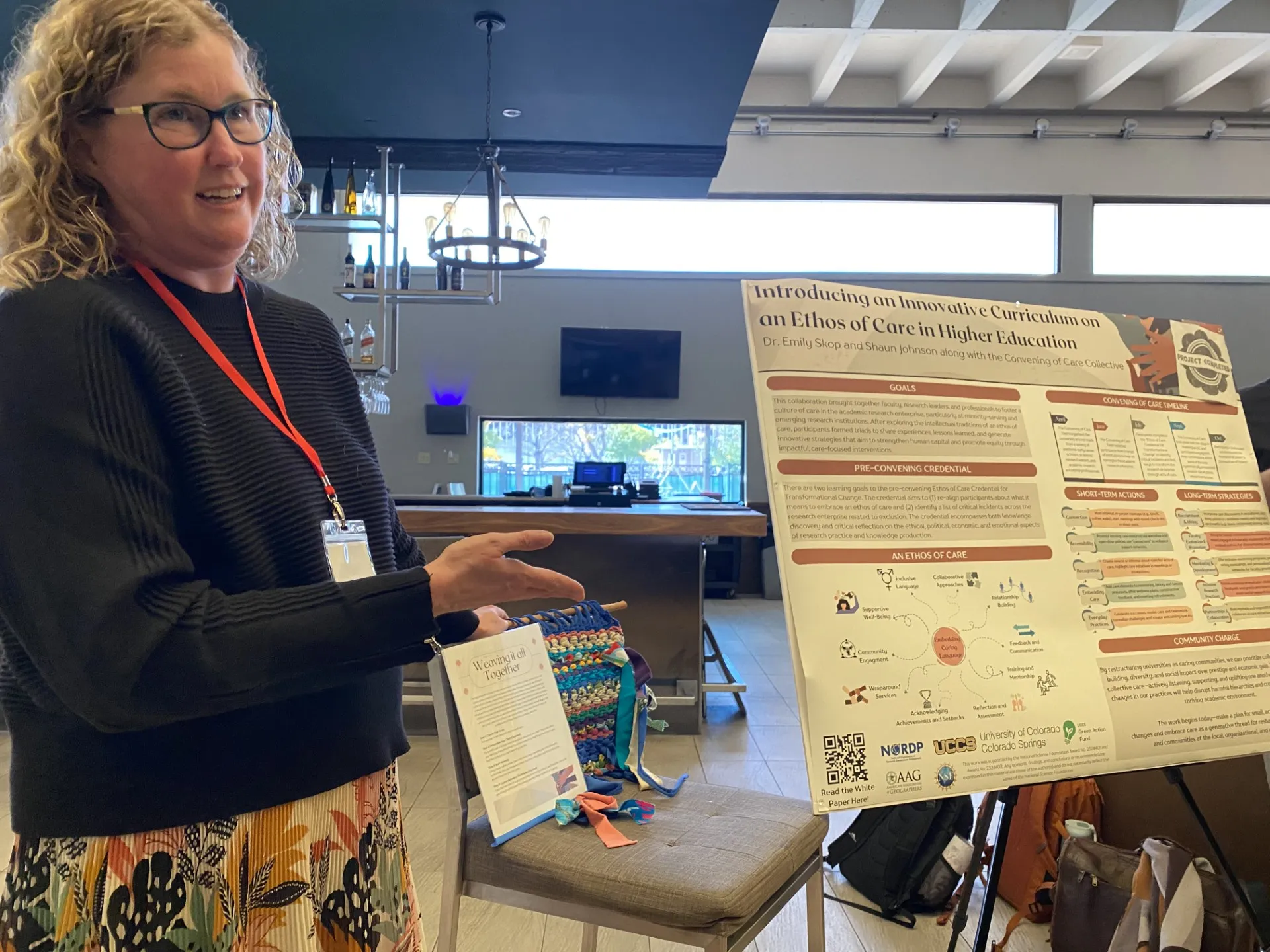
The 8-week long course leads to a credential: "The Ethos of Care Credential for Transformational Change," which the inaugural participants indicated was a very meaningful element of the convening.


Timeline
DELIVERABLES
- 8-week pre-work curriculum and guided participant materials
- 2-day immersive “Ethos of Care” convening experience
- Facilitator guides and program toolkit
- Progressive video series (short-form modules)
Documentation of participant experiences and philosophical reflections
- Final white paper documenting outcomes, insights, and recommendations
Summer Development
Summer/Fall 2026
- Finalize program structure (8-week pre-work + 2-day convening)
- Develop pre-work curriculum and materials
- Produce and begin rollout of video series + “Tidbits of Care” content
- Launch participant application and recruitment process (staff, faculty, leaders)
Campus Workshop
January 2027
- Participants complete 8-week pre-work leading into event
- Host 2-day immersive convening experience
- Facilitate workshops, collaborative sessions, and reflection activities
- Capture participant feedback, insights, and engagement data
Follow Up and Publication
January to May 2027
- Analyze participant feedback and program outcomes
- Develop and publish final white paper
- Refine program model for future iterations or scaling